
Tuesday 10 November 2026
I spent quite a lot of Tuesday working on two of the development tools I’ve been building to help me manage the increasingly complicated collection of projects that make up Niche Clever. I also managed to get back into some substantial development work on Niche Clever Interactive Core, and spent rather more time than I’d intended preparing an application for an AI-related role.
There’s a connection between quite a lot of this work, which has to do with how I keep track of what’s been done, how I establish that it’s actually been done, and how I turn the resulting material into something useful.
Finding the missing history
I’ve mentioned before that I’m developing a method for turning software development records into readable accounts of individual projects. There’s a substantial amount of material to work with, including conversations, code repositories, progress reports and the decisions recorded along the way, and I’ve been trying to develop a reasonably systematic way of bringing it all together.
The process involves two of my own development tools. One collects and organises information from the various projects, while the other uses that information to construct a more structured picture of their development. The second is effectively a projection of the first, taking the accumulated records and making them available for further analysis and, ultimately, for telling the stories of the projects themselves.
I’d been running a refresh of these histories, looking for material that had been missed and identifying additions to the existing accounts. Unfortunately, the results weren’t quite what I’d expected. There were gaps, including some fairly substantial pieces of recent development that I knew ought to have been there.
Tuesday’s investigation identified two problems. The first was in the original collection process, where some dated sections of progress files weren’t being picked up because they had been written as ordinary prose rather than structured lists. The second was in the subsequent comparison process, which was working from a filtered version of the histories rather than the complete underlying material.
The encouraging discovery was that 128 historical records which appeared to have disappeared were still present in the source files. They hadn’t been lost, which was something of a relief, but the process wasn’t using them properly.
By the end of the investigation I had a much better understanding of what had gone wrong, together with a proposed approach to correcting it. There’s more work to do on the implementation, but at least I know what I’m dealing with.
Telling the stories of the projects
This led into some further work on how the project histories themselves are constructed, and particularly how I can make the process more systematic without losing the detail that makes the accounts useful.
I’ve accumulated an enormous amount of development material over the last year, and I don’t particularly want to have to reconstruct the history of a project every time I return to it. That’s especially true when I’ve been working with several different AI agents, each of which may have contributed to different parts of the development.
The histories are intended to provide some continuity. They’re useful to me, certainly, but they’re also a way of giving the agents a more complete account of what’s happened before they start making changes.
I also returned to the Personal Workbench rebuild, which is part of the wider effort to make these tools and records work together.
The next stage of the history work will involve reviewing projects individually, or in coherent groups, rather than trying to process everything at once. Some of the material will eventually contribute to version 11 of my Interactive Professional Portfolio, although the histories have a useful existence independently of that.
Getting Core closer to release
I also got properly back into the development of Niche Clever Interactive Core, working with Claude on version 1.0.7 and the remaining work needed before resubmitting it to WordPress.org.
It’s been a rather lengthy process, and one that has involved considerably more testing and revision than I’d originally anticipated. Tuesday included further work on the way the plugin handles requests through proxy servers, improvements to maintenance error reporting, some code tidying and changes to the release packaging.
An independent review also turned up several details that needed attention, including the licensing information for the plugin’s graphics, documentation and some smaller compatibility issues. We worked through those findings and produced another release candidate, with the automated tests passing and successful installations and connection tests on two local WordPress sites.
I also prepared replacement screenshots for the WordPress.org listing, showing the current version of the plugin rather than some of the earlier interfaces.
One of the difficulties with a release process like this is keeping track of exactly where things stand. There are technical tests, packaging requirements, documentation, licensing questions and decisions that can’t really be made by an automated test. It’s quite possible to have a plugin that works perfectly well and still have a substantial list of things to do before it’s ready for distribution.
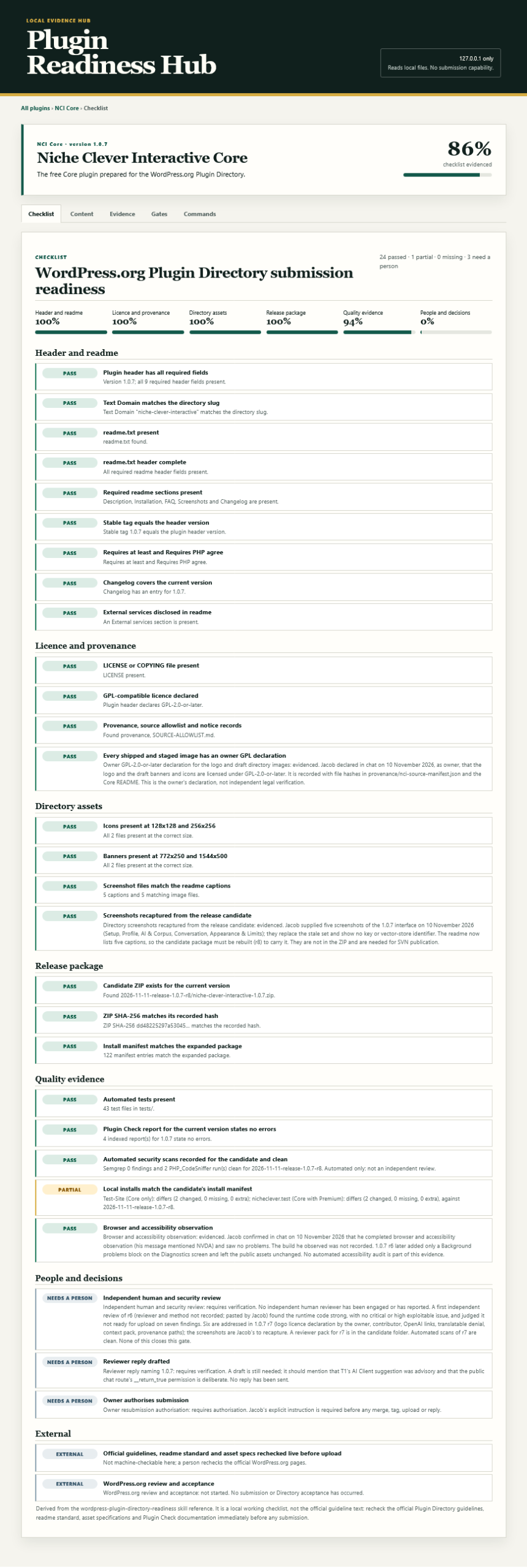
I’ve built a small tool called the Plugin Readiness Hub to help with this. It reads the local development files and presents the release requirements as a checklist, showing what’s passed, what’s incomplete and what still needs a person to review or decide. It also brings together information about the release package, supporting evidence and the remaining steps towards submission.
The screenshot gives a reasonably good impression of what it does. Core is currently showing 86% of its checklist evidence complete, which is encouraging, although that doesn’t mean there’s an 86% chance of getting through the WordPress.org review. There are still some human decisions and independent checks to complete, and the tool makes those outstanding jobs rather more obvious.
It’s a useful little addition to the development environment, particularly as I’m likely to be going through similar processes with other plugins. I’d much rather have a clear picture of what’s left to do than keep discovering another requirement just when I think I’m finished.
An application for the interactive portfolio
I also spent more time than I’d planned preparing an application for an AI Adoption Specialist role. This involved several revisions of my CV and covering letter, trying to bring together the different strands of my experience in software, publishing, consultancy and AI development into something that would make sense to a prospective employer.
One of the more interesting parts was including a link to my Interactive Professional Portfolio, with a question specifically designed around the role:
How does Jacob Bettany’s experience in AI-assisted development, professional training, digital publishing and organisational systems make him well suited to an AI Adoption Specialist role? Draw on practical examples from his career, current projects and approach to helping people understand and use technology.
https://www.nicheclever.co.uk/ask/?ncli_q=ai-adoption-specialist
The idea is that a recruiter can ask questions about my experience and the work I’ve done, rather than being limited to whatever I can fit into a conventional CV. Whether recruiters will actually use it is another matter, but I think it’s an interesting application of the technology.
It also raises a question I’ve been thinking about more generally. AI makes it remarkably easy to construct a convincing account of someone’s professional history, whether or not that account bears much relationship to reality. It would be perfectly possible to build an impressive interactive portfolio around a largely fictional career.
The harder part is assembling the evidence that supports the account, establishing where the information came from and making it possible to examine the work behind the claims. That’s where I’ve put a great deal of effort into my own portfolio. Building a WordPress plugin is pretty easy these days, it’s the corpus building which is the tricky part – and where the expertise lies.
Back to the work
So Tuesday turned out to be a fairly substantial day, with progress on the development histories, the Workbench infrastructure and Core, alongside rather more time spent on the job application than I’d intended.
I’m pleased with where Core has got to, although I’ll be happier when the WordPress.org submission is finally out of the way. The readiness checklist is helping with that, and I can see it becoming useful across the other plugins as well.
Wednesday is going to involve some client work, alongside continuing with Core where I can. There’s plenty still to do, but at least I have a rather clearer picture of what that involves.
Export and share