
Wednesday 11 November 2026
Wednesday was a fairly substantial day, with quite a lot of progress on Niche Clever Interactive Core and some further work on the project histories I’ve been developing. I also spent some time researching the economics of WordPress plugins, particularly as I’m getting closer to building the commercial infrastructure for Niche Clever Interactive Premium.
The most frustrating part of the day came when I returned to the public-facing interface of Core. I’d spent so much time concentrating on the back end, the technical requirements and the process of getting the plugin accepted by WordPress.org that I’d rather neglected the appearance of the thing people would actually be using. It was a slightly irritating discovery, particularly at this stage of development, but one that needed dealing with.
Getting the Ask panels right
The problem was with the Ask panels, the question-and-answer interfaces that website owners can embed in their pages. There are three presentation styles, and although they were functional, I wasn’t particularly happy with the typography, spacing or general appearance. Some of the styling also behaved rather differently depending on the WordPress theme surrounding it.
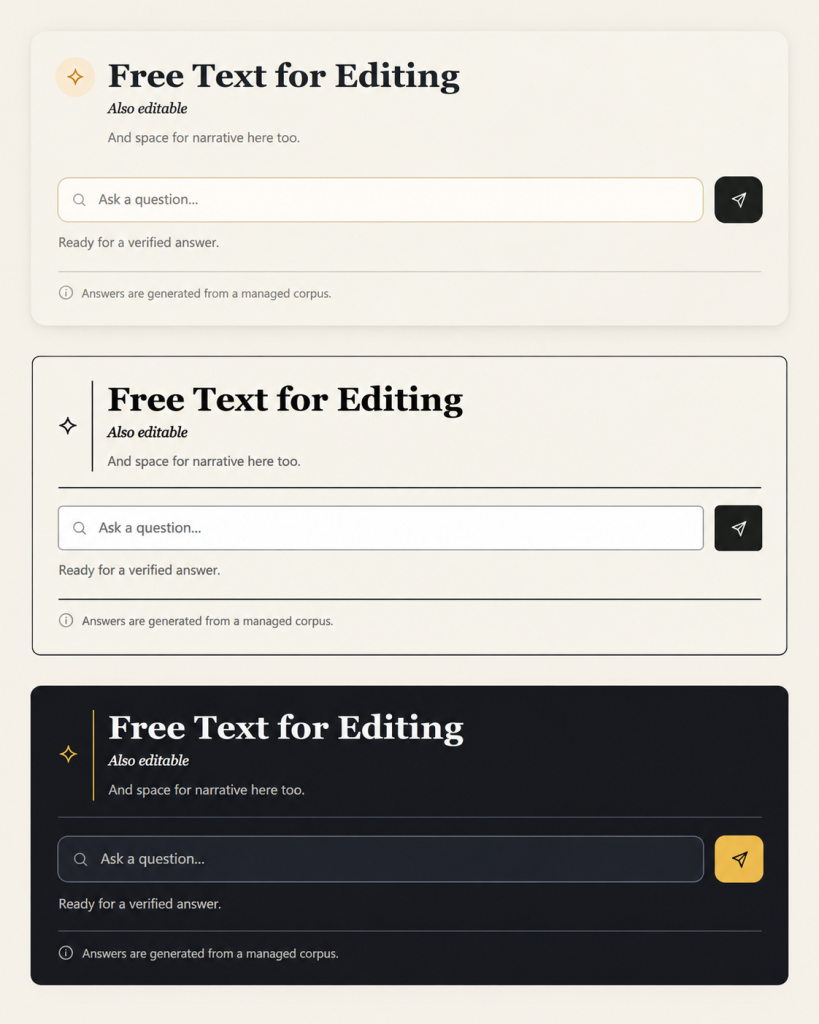
I spent some time reviewing the existing designs and HTML, then worked with Claude Code on a more consistent approach. The three styles are now Editorial, Classic and Dark, with improvements to the layout, question field, buttons and the way responses are displayed. The intention is to provide something that looks reasonably good out of the box, while still allowing site owners to adapt it to their own websites.
The difficulty, of course, was that changing the interface at this stage meant reopening parts of the review process I’d already been through. The changes needed testing against different themes and screen sizes, and another round of independent review to make sure nothing had been broken along the way.
It’s been a rather lengthy process getting Core ready for WordPress.org, and I would quite like to finish it. But there’s little point in going through all that work to produce a plugin that’s technically sound if the interface isn’t as good as it ought to be.
By the end of Wednesday, the latest local candidate was version 1.0.7 r13. The automated PHP and JavaScript tests were passing, Plugin Check reported no errors on the disposable test installation, and the three panel styles had been exercised against the Niche Clever theme at desktop and mobile widths. There was still another independent review to complete before resubmission, but the interface was looking considerably better.
Developing the project histories
I also continued working on the project histories, which I’ve mentioned in previous entries. The idea is to take the substantial collection of development records I’ve accumulated and turn them into readable accounts of how individual projects have evolved, including the decisions, experiments and changes of direction along the way.
Wednesday’s work involved reviewing candidate histories for the Niche Clever website rebuild, the Interactive Professional Portfolio and its predecessors, and Niche Clever Interactive itself. These are fairly complicated projects, and there’s a lot of material spread across conversations, repositories and progress reports.
The challenge is partly one of organisation, but it’s also about telling the stories properly. A chronological record of changes is useful, but it doesn’t necessarily explain why something was built in a particular way, or how one piece of work led to another.
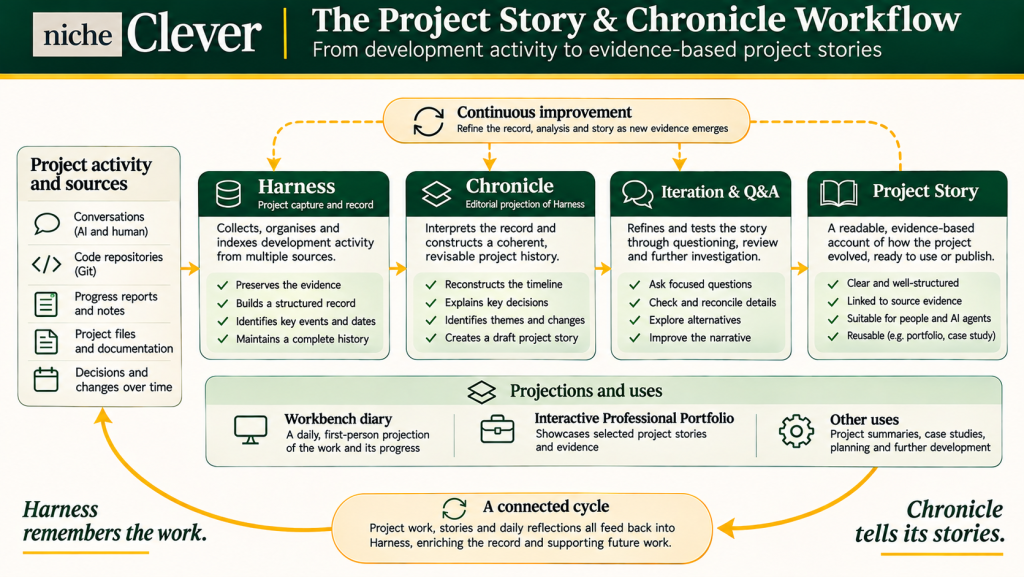
I’ve been developing two connected tools to help with this. Harness collects and organises the underlying development evidence, while a second system, which I’m now calling Chronicle, constructs editorial histories from that material. Chronicle is essentially an editorial projection of Harness, turning the structured record into an account of what happened, why it happened and how a project evolved.
The process is iterative. The initial chronology can be questioned, corrected and expanded, with further investigation feeding back into the underlying record. Different accounts can then be developed from the same material, depending on whether the purpose is a technical history, a case study or something intended for a wider audience.
As part of that exercise I also spent quite a lot of time on the history of my publishing work with Richard Craven. This involved a fairly detailed question-and-answer exercise, going through the catalogue, the Kindle editions, the publishing pipeline and the development of the Editorial Knowledge Map.
There’s also an interesting circularity in the whole process. These daily Workbench entries are themselves editorial accounts of the work, drawing on the development records and conversations to reconstruct what I’ve been doing. But the entries then become part of the record that Harness can draw on in future. In putting them together, I sometimes clarify things that weren’t particularly obvious from the technical reports alone.
The histories are useful when returning to projects after some time away, but they’re also increasingly important when working with AI agents. Having a coherent account of what has already happened makes it much easier to continue development without repeatedly reconstructing the background.
Some of the material will also contribute to version 11 of my Interactive Professional Portfolio, although the project histories have a useful existence independently of that.
A little plugin economics
I also spent some time researching the economics of WordPress plugins, looking at how developers generate revenue and the different approaches to free and premium products.
It’s particularly relevant because, once Core is available through WordPress.org, I want to move on to the commercial side of Niche Clever Interactive. There’s already been a substantial amount of planning around Premium, including its licensing and subscription model, and I’m looking forward to starting the implementation.
The part I’m particularly interested in is the infrastructure for selling it: how subscriptions are managed, how licences are issued and validated, how payments and renewals are handled, and how the different components work together.
That’s a rather different challenge from developing the plugin itself, and one I’m looking forward to getting into. There’s still some research to do, but the architecture has already been thought through in considerable detail.
A few other things
I also spent a little time investigating the website’s traffic figures. I’ve been using Google Analytics 4, but the amount of traffic it can reliably report has become less clear, particularly with consent requirements and visitors who block tracking. I started looking at whether the server statistics available through IONOS might give me another way of understanding how much traffic the site is actually receiving.
The daily opportunity scan continued in the background as well, identifying another potentially relevant consultancy role. I didn’t develop a new application from it, but it’s useful to keep that research running alongside the software and publishing work.
Where I left things
By the end of Wednesday, I’d made substantial progress on Core, although the unexpected work on the Ask panels had added another round of testing and review to an already rather lengthy submission process. The project histories were also moving forward, including a useful reconstruction of the Richard Craven publishing work, and I’d spent some time thinking about the next commercial stage of Niche Clever Interactive.
Thursday is going to involve getting on with Richard’s new website, alongside continuing with Core where I can. I’d also like to get properly into building the infrastructure for selling Premium, once the WordPress.org submission is finally out of the way.
There’s quite a lot still to do, but the pieces are gradually coming together.
Export and share